Is Grip Strength a Sign of Good Health?
What your grip strength says about how you're ageing, and how to make it stronger
How hard you can squeeze your hand sounds like a party trick, not a health check. But grip strength is one of the simplest and most studied markers of how well you're ageing. As a personal trainer in Redcliffe, I think it's worth understanding, especially if you're over 40. Here's what the research says your grip can tell you, and what actually makes it stronger.
Why does grip strength matter for your health?
Grip strength is easy to measure with a simple handheld device called a dynamometer, so researchers have tested it in millions of people and followed them for years. It's useful because it reflects your overall muscle strength, not just your hands. People with a weak grip tend to be weaker everywhere else too.
Is grip strength linked to living longer?
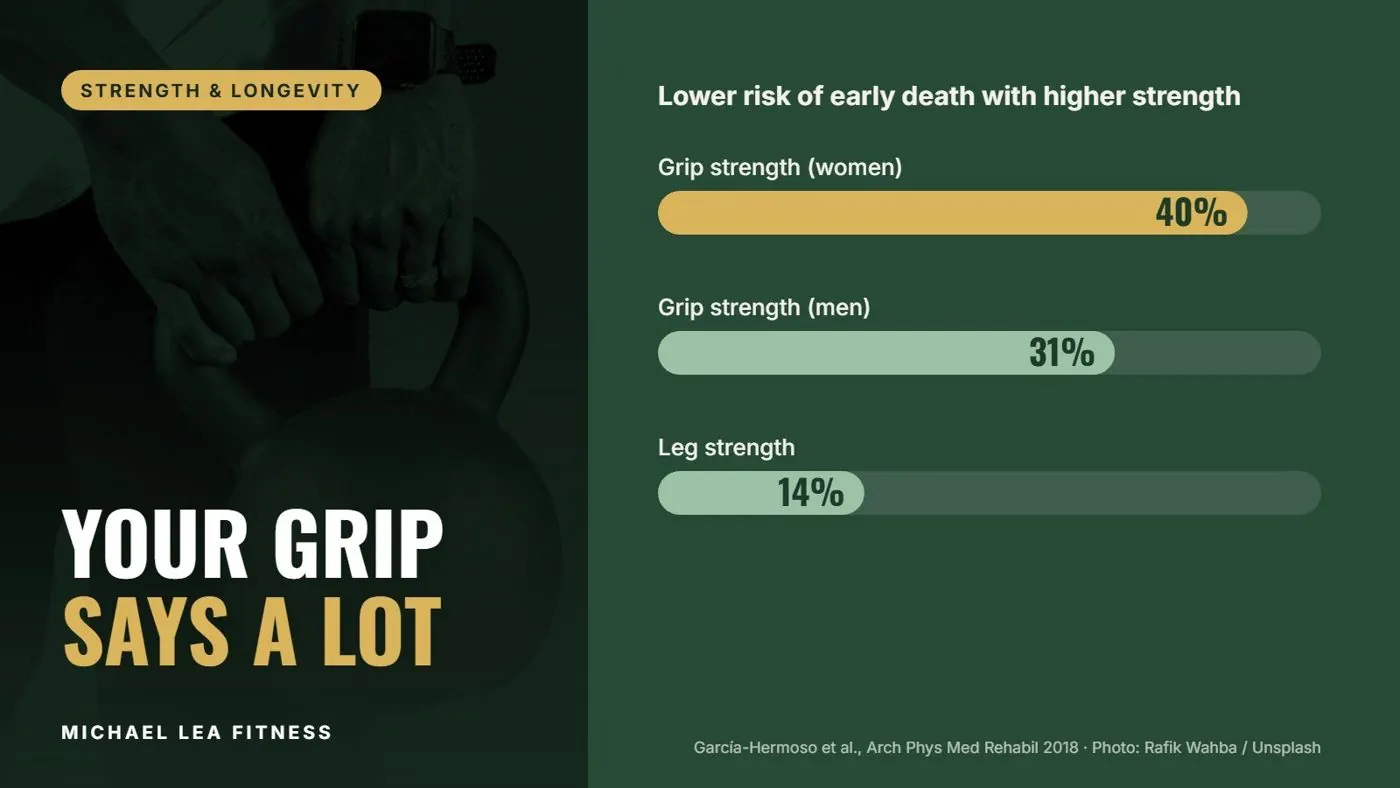
Strongly. A meta-analysis of 38 studies and nearly 1.9 million adults found that people with higher grip strength had a 31% lower risk of dying early than people with lower grip strength. The link was slightly stronger in women (40% lower risk) than in men (31%). Leg strength showed the same pattern, with stronger legs linked to a 14% lower risk (García-Hermoso et al., 2018).
A larger 2022 analysis of 48 studies and more than 3.1 million people aged 35 to 85 found a dose-response pattern. Across the range of about 26 to 50 kg, every step up in grip strength was linked with a lower risk of death from any cause (López-Bueno et al., 2022).
One honest caveat: these studies show a link, not proof that a stronger grip itself keeps you alive. Grip strength is best thought of as a window into your overall strength and health.
Does grip strength affect independence as you age?
Yes. A meta-analysis of studies in adults aged 65 and over found that low grip strength was linked with a 51% higher chance of losing the ability to do everyday tasks on your own, like dressing, bathing and getting around the house (Wang et al., 2020). Low leg strength and slow walking speed showed similar links. Strength is a big part of staying independent.
Can you improve your grip strength?
You can. A meta-analysis of 24 trials in healthy adults with an average age of 73 found that exercise training produced small but significant improvements in grip strength. Programs that included task-specific work or a mix of strength, balance and other training seemed to work best (Labott et al., 2019).
In older adults with sarcopenia (age-related muscle loss), a network meta-analysis of 42 trials found that resistance and balance training combined with good nutrition was the most effective way to improve grip strength, improving it by about 4 kg more than usual care (Shen et al., 2023).
Should you just train your grip?
Not on its own. Squeezing a grip trainer in front of the TV won't undo years of inactivity, because grip strength matters mostly as a sign of how strong you are overall. The goal is to get stronger everywhere, with your grip coming along for the ride. The good news is that many of the best strength exercises train your grip automatically.
A personal trainer's tips for building a stronger grip
- Carry heavy things. Farmer's carries, where you walk while holding a heavy dumbbell or kettlebell in each hand, are one of the best grip builders there is.
- Pull and hinge. Rows, deadlifts and pulldowns all make your hands work hard while training your back and legs.
- Hang on. If you can, practise hanging from a bar for a few seconds at a time and build up.
- Train your legs too. Leg strength showed the same link with living longer, so don't skip squats and step-ups.
- Check with your GP if you have arthritis, a hand or wrist injury, or a heart condition before starting heavy carries or hangs.
What this looks like in a 30-minute session in Redcliffe
In a 30-minute personal training session at my Redcliffe studio, grip work is built into the whole session rather than tacked on. A typical session might include a hinge or deadlift, a row, a press and a squat, then finish with a few rounds of farmer's carries. Outdoors, the same idea works with kettlebells on the grass. You get stronger from head to toe, and your grip improves along the way.
The bottom line
Grip strength is a simple, well-studied marker linked with living longer and staying independent as you age. It reflects your overall strength, so the best way to improve it is to train your whole body consistently, with plenty of carrying, pulling and lifting. That's exactly how I approach it with my personal training clients in Redcliffe.
Grip strength FAQs
How is grip strength measured?
With a handheld dynamometer that you squeeze as hard as you can. It's usually done a few times with each hand.
Do grip trainers work?
They can strengthen your hands, but on their own they won't make you stronger overall. Use them as an extra, not a replacement for full-body strength training.
Is it too late to improve my grip after 60?
No. The trials showing improvements were in adults with an average age of 73, so it's never too late to start.
Personal training in Redcliffe and Brisbane's northside
If you're around Redcliffe, Scarborough, Clontarf, Margate, Kippa-Ring or anywhere in Moreton Bay and want to build real-world strength that lasts, let's talk. Book a free consultation: call or text Michael on 0414 183 715 or email [email protected].
References
García-Hermoso A, et al. Muscular strength as a predictor of all-cause mortality in an apparently healthy population: a systematic review and meta-analysis of data from approximately 2 million men and women. Arch Phys Med Rehabil. 2018;99(10):2100-2113.e5. doi:10.1016/j.apmr.2018.01.008
López-Bueno R, et al. Thresholds of handgrip strength for all-cause, cancer, and cardiovascular mortality: a systematic review with dose-response meta-analysis. Ageing Res Rev. 2022;82:101778. doi:10.1016/j.arr.2022.101778
Wang DXM, et al. Muscle mass, strength, and physical performance predicting activities of daily living: a meta-analysis. J Cachexia Sarcopenia Muscle. 2020;11(1):3-25. doi:10.1002/jcsm.12502
Labott BK, et al. Effects of exercise training on handgrip strength in older adults: a meta-analytical review. Gerontology. 2019;65(6):686-698. doi:10.1159/000501203
Shen Y, et al. Exercise for sarcopenia in older people: a systematic review and network meta-analysis. J Cachexia Sarcopenia Muscle. 2023;14(3):1199-1211. doi:10.1002/jcsm.13225
Photo: Rafik Wahba on Unsplash.