How Do Men Over 40 Lose Belly Fat? What the Research Says
What the research says actually shifts belly fat for men over 40, and how much exercise it takes
Over 40 and getting back into training? Grab my free Week Zero starter kit: one test, one 35-minute home session and the traffic lights that stop you wrecking yourself in week one.
Past 40, the belly seems to arrive on its own. You eat roughly the same, train a bit less than you used to, and the waistband gets tighter every year. For a lot of blokes, that belly is the thing that finally gets them back into training. The good news is that the research on losing belly fat is clear, practical and, in one way, better news than you might expect. Here's what actually works.
Why do men gain belly fat after 40?
There are two kinds of belly fat. Subcutaneous fat sits under the skin and is the bit you can pinch. Visceral fat sits deeper, packed around your organs, and it's the one that matters most for your health, because it's closely tied to heart disease and type 2 diabetes. Men tend to store more fat in this deep, visceral spot, and less activity, more sitting and lost muscle over the years all make it easier to gain.
Can exercise reduce belly fat without losing weight?
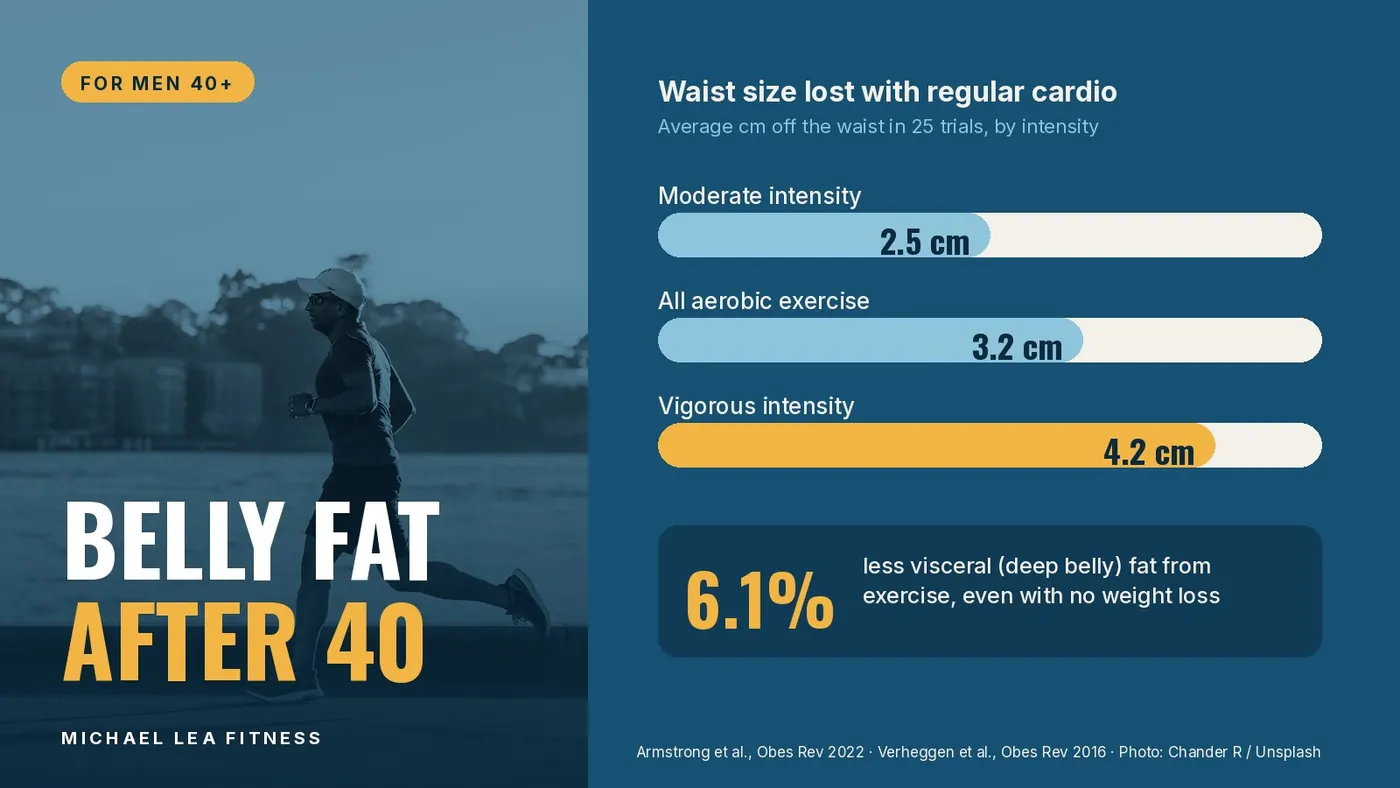
Yes, and this is the encouraging part. A large review of 117 studies with more than 4,800 people compared exercise with dieting. Dieting caused more weight loss on the scales, but exercise tended to have a bigger effect on visceral fat. Even when people didn't lose any weight at all, exercise was linked with a 6.1% drop in visceral fat, while dieting without weight loss barely changed it (Verheggen et al., 2016).
In other words, the scales can lie. If you're training and your weight hasn't moved, you may still be losing the belly fat that matters most.
What is the best exercise to lose belly fat for men over 40?
The short answer is the one you'll do consistently, but the research does point somewhere. A 2024 network meta-analysis of 84 trials and more than 4,800 people with overweight or obesity found aerobic exercise, resistance training, the two combined, and high-intensity interval training (HIIT) all reduced visceral fat. Vigorous aerobic exercise and HIIT ranked as the most effective, and strength training on its own ranked lowest overall, although it did reduce visceral fat in men (Chen et al., 2024).
Intensity seems to matter. A meta-analysis of 25 trials led by University of Sydney researchers found regular aerobic exercise cut waist size by an average of 3.2 cm, with vigorous exercise taking off about 4.2 cm compared with 2.5 cm for moderate exercise (Armstrong et al., 2022).
How much exercise do you need to lose belly fat?
More tends to be better. A 2024 analysis of 116 trials found every extra 30 minutes of aerobic exercise a week was linked with about half a centimetre off the waist and half a kilo off the scales. The authors concluded that around 150 minutes a week of moderate-to-vigorous exercise is where the changes become clinically meaningful, with benefits continuing up to about 300 minutes a week (Jayedi et al., 2024).
Another meta-analysis of 40 trials found the same pattern for visceral fat specifically: the bigger the weekly energy burn from exercise, the more visceral fat came off (Recchia et al., 2023).
Does lifting weights help you lose belly fat?
It helps, and it does a job cardio can't. A meta-analysis of 58 studies led by researchers at UNSW Sydney found resistance training on its own reduced body fat percentage by about 1.5%, cut fat mass by about half a kilo and reduced visceral fat, even without changes to diet (Wewege et al., 2022). It also builds and keeps muscle, which most men start losing after 40. The best plan combines both: lift for muscle, and add harder cardio for the deep belly fat.
How to lose belly fat after 40: practical tips
- Lift two or three times a week. Squats, deadlifts or hinges, rows, presses and carries, with the weight going up over time.
- Add some hard cardio. One or two sessions a week of intervals or vigorous efforts on the bike, rower or hills.
- Build towards 150 minutes a week. Walks, rides and training sessions all count. Start where you are and add a little each week.
- Measure your waist, not just your weight. A tape measure around your belly button once a fortnight tells you more than the scales.
- Sort your food too. Exercise is powerful for belly fat, but eating in a sensible calorie deficit with plenty of protein speeds things up.
- Check with your GP before starting hard training if you have heart problems, high blood pressure or diabetes.
When a bloke over 40 starts training with me, a typical 30-minute session is two strength supersets built around a squat or hinge, a row and a press, then a short, hard finisher on the bike, rower or sled. Two or three of those a week, plus a few brisk walks, gets most men close to that 150-minute mark without living in the gym.
Frequently asked questions
Can you spot-reduce belly fat with sit-ups?
No. Sit-ups and crunches strengthen your abs, but they don't burn the fat sitting on or around them. Belly fat comes off with whole-body training and diet.
How fast can I lose belly fat after 40?
It varies from person to person, but in the research, consistent training over a few months produced measurable drops in waist size and visceral fat. Measure your waist every couple of weeks and focus on the trend.
Why is my weight not changing even though I'm training?
Exercise can reduce visceral fat even when the scales don't move, and lifting builds muscle at the same time. Your waist measurement is a better guide than your weight.
The bottom line
Belly fat after 40 isn't inevitable, and you don't need to starve yourself to shift it. Regular exercise, especially harder cardio combined with strength training, reduces the deep visceral fat that matters most for your health, even before the scales budge. If you're getting back into it, the free Week Zero starter kit is a simple place to begin.
References
Verheggen RJHM, et al. A systematic review and meta-analysis on the effects of exercise training versus hypocaloric diet: distinct effects on body weight and visceral adipose tissue. Obes Rev. 2016;17(8):664-690. doi:10.1111/obr.12406
Chen X, et al. Effects of various exercise types on visceral adipose tissue in individuals with overweight and obesity: a systematic review and network meta-analysis of 84 randomized controlled trials. Obes Rev. 2024;25(3):e13666. doi:10.1111/obr.13666
Armstrong A, et al. Effect of aerobic exercise on waist circumference in adults with overweight or obesity: a systematic review and meta-analysis. Obes Rev. 2022;23(8):e13446. doi:10.1111/obr.13446
Jayedi A, et al. Aerobic exercise and weight loss in adults: a systematic review and dose-response meta-analysis. JAMA Netw Open. 2024;7(12):e2452185. doi:10.1001/jamanetworkopen.2024.52185
Recchia F, et al. Dose-response effects of exercise and caloric restriction on visceral adiposity in overweight and obese adults: a systematic review and meta-analysis of randomised controlled trials. Br J Sports Med. 2023;57(16):1035-1041. doi:10.1136/bjsports-2022-106304
Wewege MA, et al. The effect of resistance training in healthy adults on body fat percentage, fat mass and visceral fat: a systematic review and meta-analysis. Sports Med. 2022;52(2):287-300. doi:10.1007/s40279-021-01562-2
Photo: Chander R on Unsplash.