Strength Training Through Menopause: What Lifting Can Do
What lifting can do for hot flushes, strength, heart and bones
Hot flushes, broken sleep, creeping weight around the middle, joints that suddenly ache. Menopause can feel like your body has changed the rules overnight. As a personal trainer in Redcliffe, I work with plenty of women in their 40s and 50s who've been told to "just walk more". Walking around the Redcliffe foreshore is great, but the research points to something more powerful for this stage of life: lifting weights. Here's what the evidence says, and how to start.
Can strength training help with hot flushes?
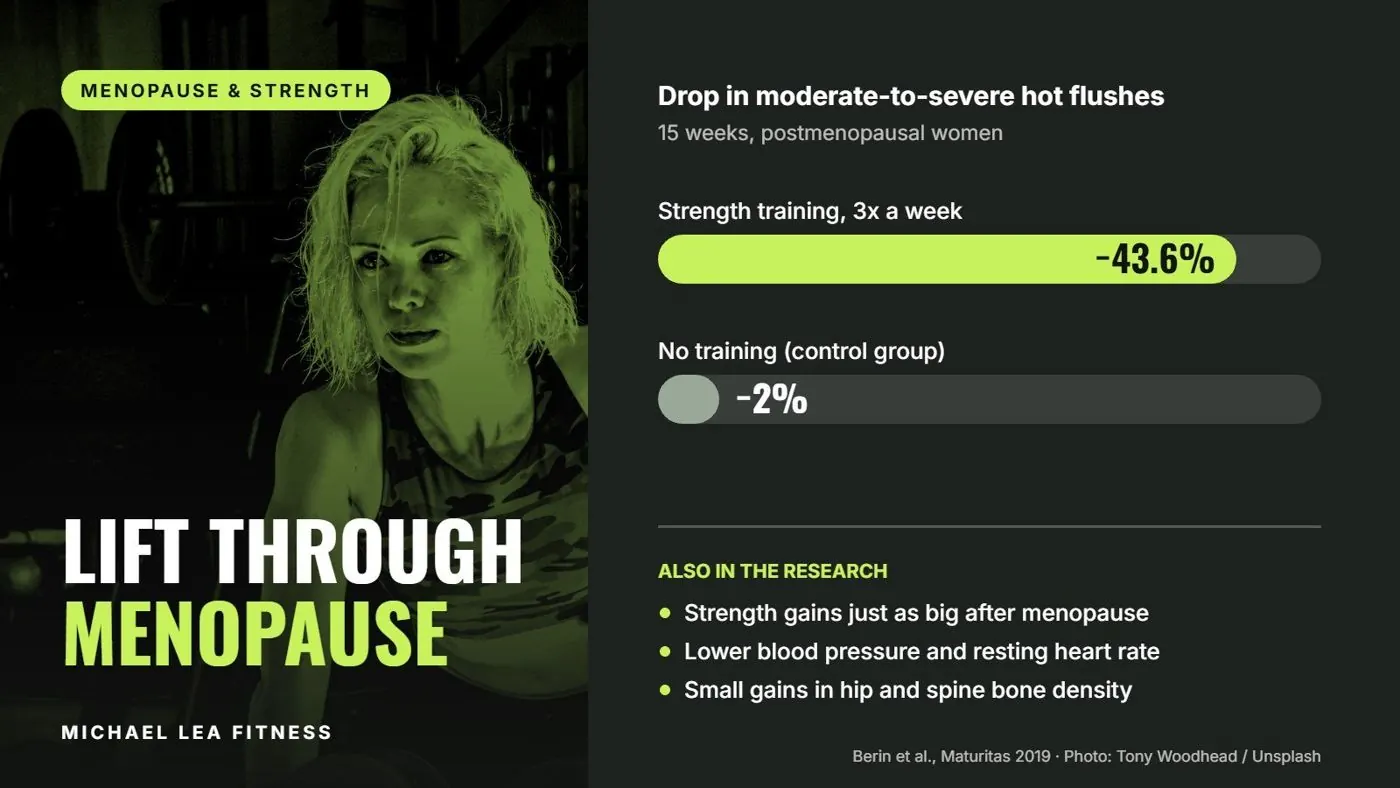
It looks like it can. In a Swedish randomised controlled trial, 58 postmenopausal women who were having at least four moderate or severe hot flushes a day either did 15 weeks of strength training or carried on as usual. The training group lifted three times a week: eight exercises, two sets of 8 to 12 reps, with the weights increased as they got stronger. Their moderate-to-severe hot flushes dropped by 43.6%, compared with 2% in the group that didn't train (Berin et al., 2019).
A meta-analysis pooling five studies also found resistance training significantly reduced hot flushes in postmenopausal women (Choudhry et al., 2024). It's a small body of research, so treat this as promising rather than proven, but it's encouraging.
Do the benefits last if you stop?
Here's the honest catch. When the same Swedish group followed the women up, the training group still had fewer hot flushes than the control group six months after the program ended. By two years, the difference had disappeared (Nilsson et al., 2024). Strength training works while you keep doing it. Think of it as a habit, not a 15-week fix.
Is it too late to build strength after menopause?
No. A 2026 meta-analysis of 126 studies and more than 4,000 women found resistance training improved strength just as much in postmenopausal women as in premenopausal women. Women also gained functional muscle and lost fat mass, and the results weren't linked to age (Isenmann et al., 2026). The title of the paper says it all: it's never too late.
What does lifting do for your heart and bones after menopause?
Heart disease risk rises after menopause. A 2026 review of 60 studies found resistance training lowered resting heart rate and blood pressure in postmenopausal women, with no harmful changes to heart structure (Rivera-Mejía et al., 2026).
Bones matter too, because falling oestrogen speeds up bone loss. A 2026 meta-analysis of randomised trials found high-intensity, impact and strength training produced small but significant improvements in bone density at the hip and spine in postmenopausal women (Jones et al., 2026). The effect is modest, but holding on to bone is a win at this stage of life.
How to start strength training through menopause
- Two to three sessions a week. The hot flush trial used three; two well-structured sessions is a realistic starting point.
- Big movements first. Squats, hinges, rows, presses and carries work the most muscle in the least time.
- Make it challenging. The last couple of reps of each set should feel hard. Add weight gradually as you get stronger.
- Keep going. The research is clear that the benefits fade when you stop, so build a routine you can stick with for years.
- Talk to your GP about menopause symptoms and treatment options. Exercise works alongside medical care, not instead of it.
What this looks like in a 30-minute session in Redcliffe
A 30-minute personal training session at my Redcliffe studio for a woman going through menopause usually looks like this: a short warm-up, two strength supersets built around a squat or hinge, a row and a press, then a few minutes of loaded carries or core work. We track the weights every week, so you can see your strength going up even on days when your body feels unpredictable. Sessions are adjusted on the day if sleep has been rough or joints are sore.
The bottom line
Strength training won't make menopause disappear, but the research suggests it can ease hot flushes, build strength at any age, and support your heart and bones. The key is to start, train with enough effort, and keep it going, whether that's in a Redcliffe studio, your local gym or your garage.
Menopause and strength training FAQs
Will lifting weights make me bulky?
No. Building noticeable bulk takes years of very specific training and eating. For most women, strength training leads to a firmer, stronger body and less fat mass.
How long before strength training helps with hot flushes?
In the main trial, women trained three times a week for 15 weeks before their hot flushes were measured again. Give it a few months of consistent training.
Is it safe to lift if I have low bone density?
Strength training is generally recommended for bone health, but if you have osteoporosis or a history of fractures, check with your GP first and work with a coach who will build the load up gradually.
Personal training in Redcliffe and Brisbane's northside
If you're around Redcliffe, Scarborough, Clontarf, Margate, Kippa-Ring or anywhere in Moreton Bay and want to feel strong through menopause and beyond, let's talk. Book a free consultation: call or text Michael on 0414 183 715 or email [email protected].
References
Berin E, et al. Resistance training for hot flushes in postmenopausal women: a randomised controlled trial. Maturitas. 2019;126:55-60. doi:10.1016/j.maturitas.2019.05.005
Choudhry DN, et al. The effect of resistance training in reducing hot flushes in post-menopausal women: a meta-analysis. J Bodyw Mov Ther. 2024;39:335-342. doi:10.1016/j.jbmt.2024.03.018
Nilsson S, et al. A 2-year follow-up to a randomized controlled trial on resistance training in postmenopausal women: vasomotor symptoms, quality of life and cardiovascular risk markers. BMC Womens Health. 2024;24(1):511. doi:10.1186/s12905-024-03351-1
Isenmann E, et al. It's never too late: the impact of resistance training on strength and body composition in females across the lifespan. J Sci Med Sport. 2026;29(10):1174-1185. doi:10.1016/j.jsams.2026.03.002
Rivera-Mejía SL, et al. Resistance training improves cardiovascular health in postmenopausal women: systematic review and meta-analysis. J Appl Physiol. 2026;141(2):619-641. doi:10.1152/japplphysiol.01180.2025
Jones E, et al. A systematic review and meta-analysis of the effects of high-intensity, impact, and strength training on bone mineral density in premenopausal and postmenopausal women. Menopause. 2026. doi:10.1097/GME.0000000000002839
Photo: Tony Woodhead on Unsplash.