Training in the Queensland Heat: A Summer Safety Guide
How to keep training safely through a Redcliffe summer, backed by the research
Summer on the Redcliffe Peninsula is beautiful, but it's not kind to anyone training in it. By late spring the mornings are already sticky, and from December the humidity off Moreton Bay can make a simple walk feel like hard work. As a personal trainer in Redcliffe, this is the time of year I see people either push too hard and feel awful, or give up training until autumn. Neither is necessary. Here's what the research says about training in the heat, and how to keep your results without cooking yourself.
Is it safe to exercise in Queensland heat?
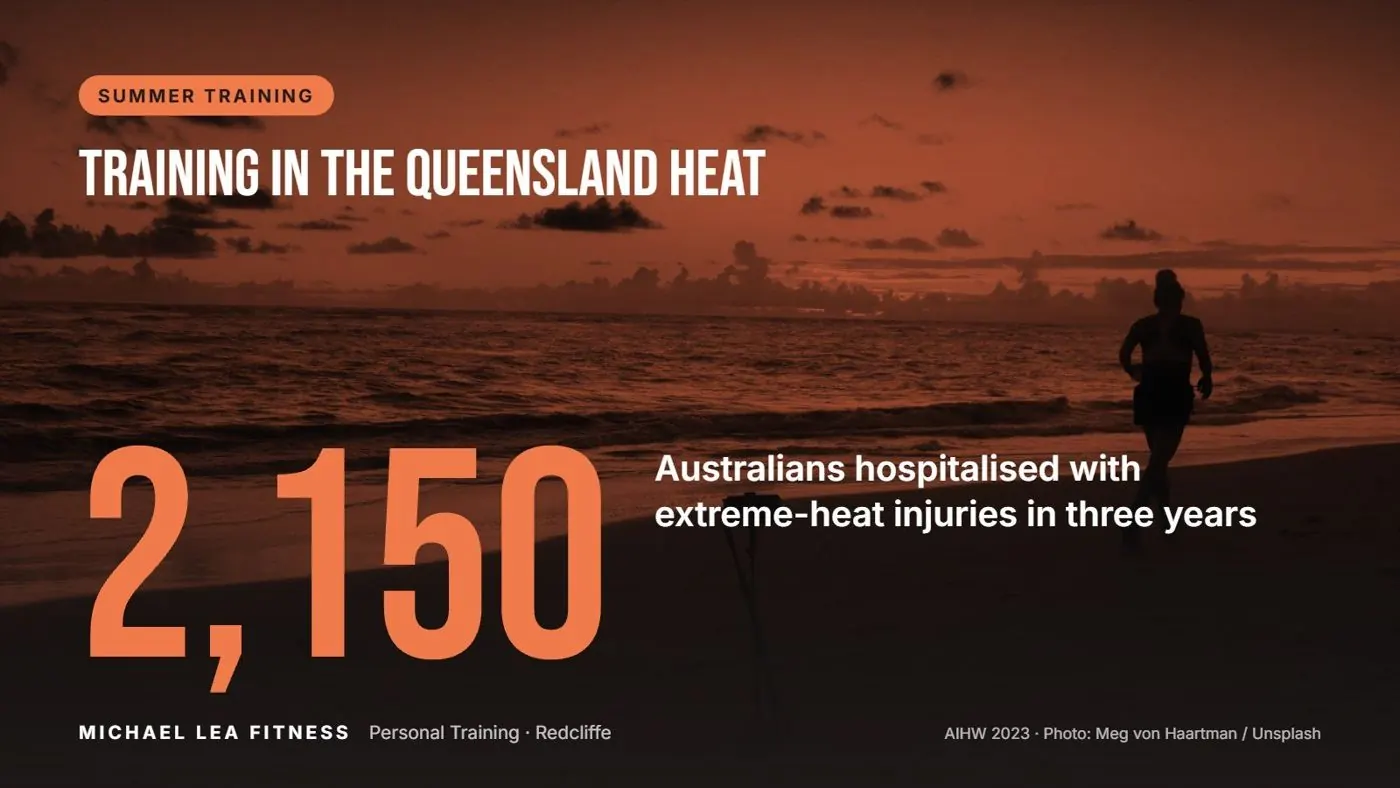
For most healthy adults, yes, as long as you respect it. But heat is the biggest weather-related injury risk in the country. Between 2019–20 and 2021–22, 2,150 Australians were hospitalised with injuries caused by extreme heat. Over the past decade, extreme heat has caused 5 to 10 times as many hospitalisations as the next most common weather cause, and people aged 65 and over are hospitalised most often (AIHW, 2023).
Humidity is the hidden problem in Redcliffe. Your body cools itself mainly by sweat evaporating off your skin. When the air is already full of moisture, less sweat evaporates, so your core temperature and heart rate climb faster at the same effort.
Why does heat hit harder after 40?
Our ability to get rid of heat drops with age. In the PSU HEAT Project, researchers exposed young, middle-aged (around 51) and older adults (around 70) to rising heat while doing light, everyday-level activity. The temperature and humidity at which core temperature started climbing out of control got lower with each age group (Cottle et al., 2024). In plain English: the older we get, the sooner the heat catches up with us.
The good news is that fitness pushes back. A review of the research on ageing and heat found that people with high aerobic fitness sweat better and have stronger heart and blood flow responses, which helps them regulate temperature at any age (Kenney et al., 2021).
What's the best way to cope with exercising in the heat?
A meta-analysis of 118 studies compared the main heat strategies: aerobic fitness, heat acclimation (training in the heat so your body adapts), cooling down before exercise, and drinking fluids. Overall, being aerobically fit was the most effective at keeping core temperature in check and protecting endurance, followed by heat acclimation (Alhadad et al., 2019). Drinking during exercise was best at slowing the rise in core temperature while you're working.
So the strongest summer strategy isn't a gadget or a supplement. It's the fitness you build in the months before summer, topped up with smart hydration.
Can your body adapt to training in the heat?
Yes. With repeated exposure your body learns to sweat earlier, keep your heart rate lower and hold a lower core temperature. A meta-analysis of studies in women found exactly these adaptations: lower exercise core temperature and heart rate, and a higher sweat rate after a period of heat training (Kelly et al., 2023). Much of the older research was done on men, so this was an important check.
The catch is that you lose it if you stop. A review of heat acclimation decay found roughly one day of adaptation is lost for every two days without heat exposure. The upside: re-adapting was 8 to 12 times faster than losing it in the first place (Daanen et al., 2018). Training consistently through the warm months keeps you adapted. Skipping three weeks in January doesn't.
A personal trainer's tips for training in the heat around Redcliffe
- Go early. Train before the sun gets high, or late in the evening once the sea breeze arrives. The middle of the day is the worst time to train outdoors.
- Build up gradually. Ease the intensity down in the first hot weeks of the season and let your body adapt before you chase personal bests.
- Drink before, during and after. Start hydrated and sip through the session, especially if it runs past 30 minutes.
- Use effort, not pace. Your heart rate will run higher in the heat. Slow down to match the effort you'd normally do, rather than forcing your usual numbers.
- Know the warning signs. Dizziness, nausea, headache, confusion or stopping sweating mean stop, get into the shade, cool down and get help if it doesn't settle quickly.
- Check with your GP if you have a heart condition, high blood pressure or take medications, as some affect how you handle heat.
What this looks like in a 30-minute session in Redcliffe
In summer, I adjust my 30-minute personal training sessions in Redcliffe to the conditions. Outdoor sessions move to the coolest parts of the day, rest breaks get longer, and water is never more than a few steps away. On the hottest, most humid days we bring the session into the studio and shift the focus to strength work, which keeps your results moving without the cardio strain of a hot run. The goal is simple: keep you training all summer instead of losing two months to the weather.
The bottom line
Heat is a real risk, especially as we age, but it's not a reason to stop. Build your fitness before summer, adapt gradually, train at the right times and listen to your body. Do that and you'll come out of a Redcliffe summer fitter, not further behind.
Training in the heat FAQs
What time of day is best to train in a Queensland summer?
Early morning is usually best, before the sun and temperature build. Late evening can also work once the heat drops.
How long does it take to get used to training in the heat?
Your body starts adapting with repeated exposure, and keeping that exposure consistent matters more than any single session. Research shows the adaptations fade if you stop, but come back faster than they took to build.
Should older adults avoid exercising in summer?
No, but they should be more careful. The research shows older adults reach their heat limits sooner, so train in cooler conditions, keep the intensity sensible and check with your GP if you have a medical condition.
Personal training in Redcliffe and Brisbane's northside
If you're around Redcliffe, Scarborough, Clontarf, Margate, Kippa-Ring or anywhere in Moreton Bay and want to keep your training on track this summer, let's talk. Book a free consultation: call or text Michael on 0414 183 715 or email [email protected].
References
Australian Institute of Health and Welfare. Let's talk about the weather: injuries related to extreme weather. 2023.
Cottle RM, et al. Critical environmental core temperature limits and heart rate thresholds across the adult age span (PSU HEAT Project). J Appl Physiol. 2024;137(1):145-153. doi:10.1152/japplphysiol.00117.2024
Kenney WL, et al. Temperature regulation during exercise in the heat: insights for the aging athlete. J Sci Med Sport. 2021;24(8):739-746. doi:10.1016/j.jsams.2020.12.007
Alhadad SB, et al. Efficacy of heat mitigation strategies on core temperature and endurance exercise: a meta-analysis. Front Physiol. 2019;10:71. doi:10.3389/fphys.2019.00071
Kelly MK, et al. Heat adaptation for females: a systematic review and meta-analysis of physiological adaptations and exercise performance in the heat. Sports Med. 2023;53(7):1395-1421. doi:10.1007/s40279-023-01831-2
Daanen HAM, et al. Heat acclimation decay and re-induction: a systematic review and meta-analysis. Sports Med. 2018;48(2):409-430. doi:10.1007/s40279-017-0808-x
Photo: Meg von Haartman on Unsplash.