AI Fitness Advice or a Real Coach? What Actually Gets Results
Why real, supervised personal training in Redcliffe still matters
If you've scrolled fitness content lately, you've probably wondered what's actually real. The perfect physique that might be edited. The program an app wrote in seconds. The "expert" who may not exist. As a personal trainer in Redcliffe, I think AI is a genuinely useful tool, but when it comes to your body, the research says it works best with a real coach in the loop. Here's what the evidence shows, and how to tell good personal training advice from noise.
Can you trust fitness content online in 2026?
Not by looks alone. Researchers testing AI-generated faces found they were indistinguishable from real ones, and people rated the fake faces as more trustworthy (Nightingale & Farid, 2022). If a face can be faked, so can a transformation photo or a testimonial.
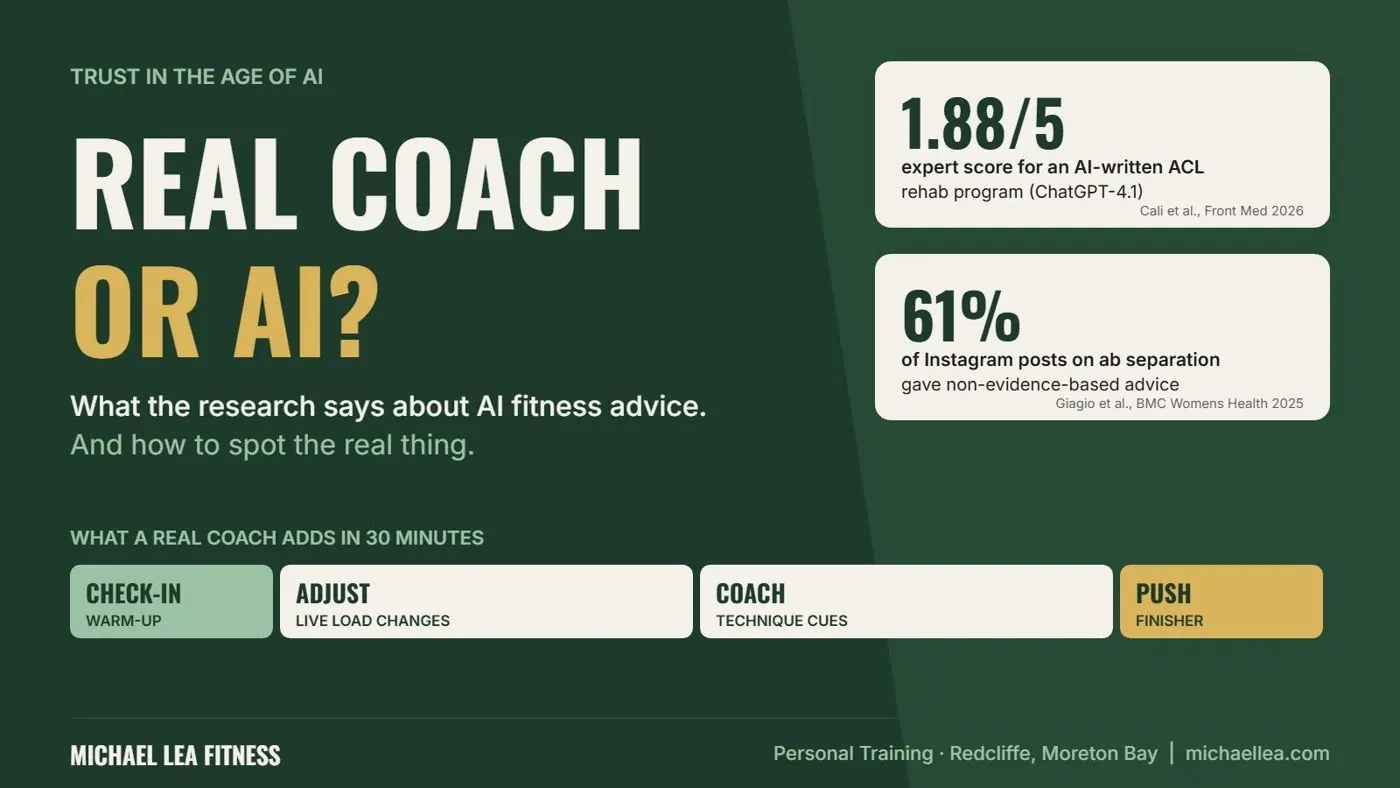
Content made by real people is patchy too. When researchers analysed Instagram posts giving exercise advice for abdominal separation after pregnancy, 61% of the posts studied offered suggestions that weren't evidence-based, and only about 7% mentioned any scientific source (Giagio et al., 2025). Confident isn't the same as correct.
Is an AI-generated workout program safe?
For simple situations, it can be decent. In a 2026 study, two experienced sports physiotherapists scored ChatGPT-written rehab programs for five injuries. The average was 3.85 out of 5, and a straightforward collarbone fracture program scored top marks. But the program for ACL reconstruction, a complex case where timing matters, scored just 1.88 out of 5 (Cali et al., 2026). The authors' conclusion: use it as a support tool under professional supervision, not on its own.
A 2026 scoping review of 32 studies on AI in sports medicine landed in the same place. Accuracy varied a lot, the risk of AI "hallucinating" was rated critical for general-purpose chatbots, and the evidence doesn't support using these tools unsupervised (Dergaa et al., 2026). One honest caveat: these studies are small and the tools keep changing, so this picture may shift.
Does supervised training get better results?
For older adults, the evidence says yes. A meta-analysis of 11 studies in healthy people aged 65+ found supervised strength and balance training improved muscle strength and power more than the same training done unsupervised (Lacroix et al., 2017). The authors suggested making around two of every three weekly sessions supervised. The studies were of moderate quality, so treat it as a strong hint rather than the final word, but it matches what coaches see: someone watching your technique and adjusting the load makes a difference.
How to spot a real personal trainer (and real advice)
Whether you train in Redcliffe or follow someone online, look for:
- They're verifiable. A real studio, a real phone number, real people you can talk to.
- They show the unpolished stuff. Actual sessions, bad days and honest numbers, not just highlight reels.
- They cite sources and say "we don't know yet" when the evidence is thin.
- They're consistent over time. Same face, same place, month after month.
- They're honest about the tools they use. A coach using AI for admin or research is fine, as long as a person makes the calls about your training.
Where AI fits in good personal training
AI is great for crunching numbers, drafting plans and sorting information. What it can't do yet is watch your squat, notice your knee caving on rep eight, see you're flat after a bad night's sleep, or know your shoulder history. The best setup in 2026 is a real coach using good tools, not tools replacing the coach.
What this looks like in a 30-minute session in Redcliffe
In a 30-minute personal training session at my Redcliffe studio, the plan is written in advance but adjusted live: load up or down based on how you're moving, a technique cue when your form drifts, a swap if something doesn't feel right. That real-time feedback is the part no app or chatbot can do for you.
The bottom line
Use AI and online content for ideas and information, but be sceptical of anything you can't verify. For your actual training, especially if you're over 40, coming back from injury or just starting out, a real, qualified coach watching you train is still the safer bet, whether that's in Redcliffe or wherever you live. Real people, real sessions, results you can check.
AI fitness advice FAQs
Can I use ChatGPT to write my workout program?
For general ideas, yes. But research shows AI programs get weaker as situations get more complex, like rehab after surgery. Have a qualified trainer or physio check it, and check with your GP if you have a medical condition.
How can I tell if a fitness influencer is real?
Look for things that are hard to fake: a real business address, consistent content over months, unedited video, and claims backed by named sources.
Is supervised personal training worth it over an app?
Research in older adults links supervised training with bigger strength gains than unsupervised training. For many people, the accountability and technique feedback alone make it worthwhile.
Personal training in Redcliffe and Brisbane's northside
If you're around Redcliffe, Scarborough, Kippa-Ring, Clontarf, Margate or anywhere in Moreton Bay and want a real person in your corner, book a free consultation. Call Michael on 0414 183 715 or email [email protected].
References
Nightingale SJ, Farid H. AI-synthesized faces are indistinguishable from real faces and more trustworthy. PNAS. 2022;119(8). doi:10.1073/pnas.2120481119
Giagio S, et al. #diastasisrecti: a mixed-methods analysis of Instagram posts and their influence on women's exercise and sports participation. BMC Womens Health. 2025;25(1):332. doi:10.1186/s12905-025-03885-y
Cali A, et al. ChatGPT-generated rehabilitation programs in sports physiotherapy: an expert evaluation and a mixed-methods study of clinical applicability. Front Med. 2026;13:1935702. doi:10.3389/fmed.2026.1935702
Dergaa I, et al. Generative artificial intelligence and large language models in sports medicine: a scoping review of applications, accuracy, and ethical implications. Front Public Health. 2026;14:1843535. doi:10.3389/fpubh.2026.1843535
Lacroix A, et al. Effects of supervised vs. unsupervised training programs on balance and muscle strength in older adults: a systematic review and meta-analysis. Sports Med. 2017;47(11):2341-2361. doi:10.1007/s40279-017-0747-6