Fall-Proof After 60: Balance and Strength Training That Works
Keeps you steady, strong and independent
Ask most people over 60 what they're worried about and "falling over" comes up quickly. As a personal trainer in Redcliffe, I hear it from clients and from their adult kids. The good news is that falls are one of the most preventable problems in ageing, and the evidence for the right kind of exercise is about as strong as exercise research gets.
How common are falls in Australia?
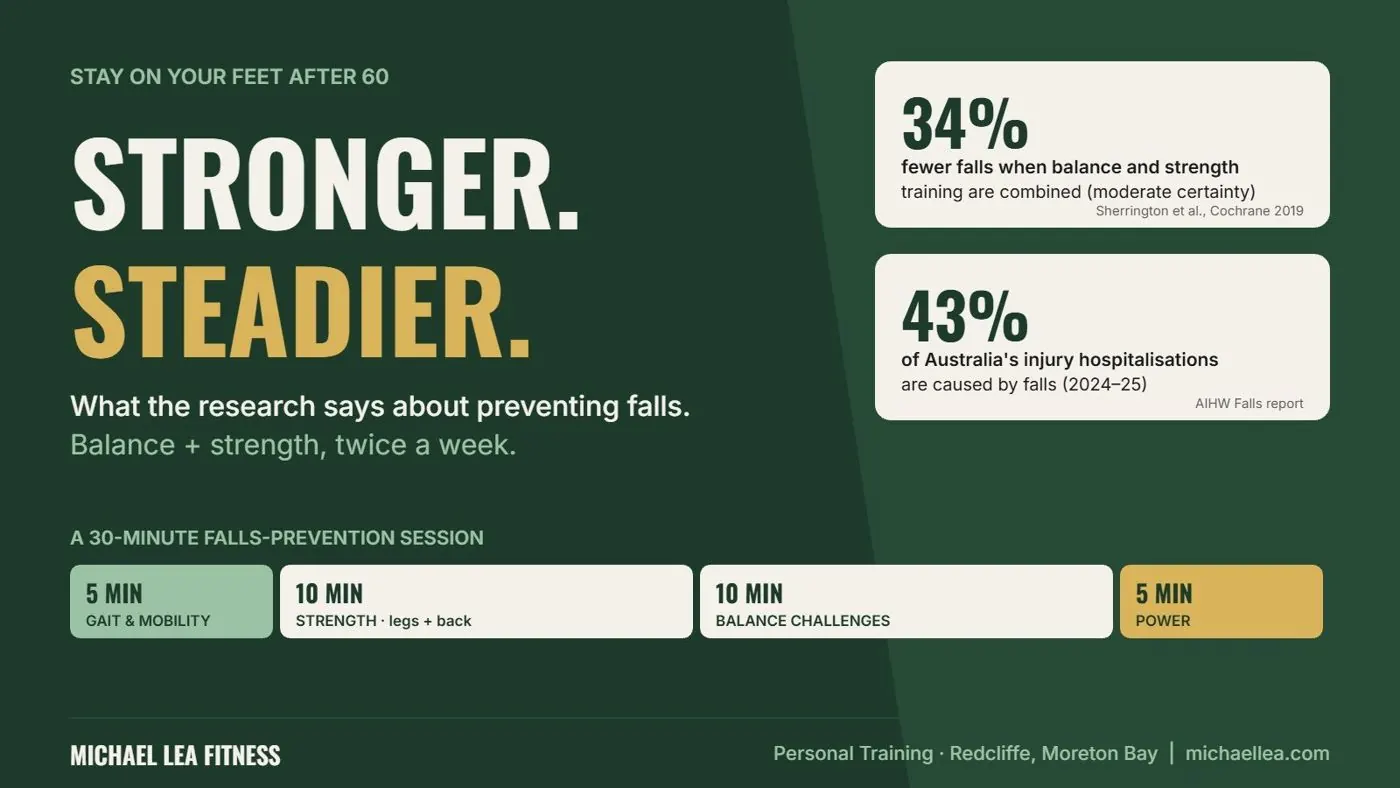
More common than most people realise. Falls caused 43.4% of all injury hospitalisations in Australia in 2024–25, around 253,800 hospital stays. People aged 65 and over were hospitalised for falls about 12 times more often than adults aged 25 to 44 (AIHW). Research reviews estimate at least one in three people over 65 living at home has a fall each year.
Behind those numbers are broken hips, lost confidence and, too often, the end of living independently. On the Redcliffe peninsula, where plenty of us have parents and grandparents nearby, that matters.
Does exercise really prevent falls?
Yes, and this one is backed by high-certainty evidence. A Cochrane review of 108 randomised trials with more than 23,000 people aged 60+ living in the community found exercise reduced the rate of falls by 23% (Sherrington et al., 2019).
The type of exercise matters:
- Balance and functional exercises (think standing on one leg, stepping, getting up from a chair) cut the rate of falls by 24%.
- Programs that combine balance work with strength training probably cut falls by 34%.
- Tai Chi may help too.
- Walking on its own, or strength training without balance work, had uncertain effects on falls.
So the evening walk along the Redcliffe foreshore is great for your heart, but on its own it isn't a falls-prevention program. You need to challenge your balance and your strength.
Is heavy lifting safe if you have weak bones?
This is where an Aussie study changed a lot of minds. In the LIFTMOR trial at Griffith University on the Gold Coast, 101 women with low bone mass (average age 65) did either a home program of gentle exercise or two supervised 30-minute sessions a week of heavy resistance and impact training: 5 sets of 5 reps at more than 85% of their maximum (Watson et al., 2018).
After eight months, the lifting group improved spine bone density by about 2.9% while the home group lost about 1.2%. They also got better at every function test, including getting up from a chair and walking. Only one minor injury was reported.
The important caveat: these women were screened first and coached closely the whole way. If you have osteoporosis or a history of fractures, talk to your GP before starting, and work with someone who knows how to build the load up safely.
What falls-prevention training looks like in a 30-minute session in Redcliffe
In a 30-minute personal training session at my Redcliffe studio, a falls-focused workout might look like this:
- 5 min, gait and mobility: marching, stepping drills, ankle and hip mobility.
- 10 min, strength: squats or sit-to-stands, deadlifts or hip hinges, rows, built up gradually to genuinely challenging loads.
- 10 min, balance challenges: single-leg stands, tandem walking, step-ups, reaching and turning, progressed as you get steadier.
- 5 min, power: faster sit-to-stands or step-ups, because reacting quickly is what saves you from a trip.
Two sessions a week is a realistic, research-backed target, and like LIFTMOR, it fits into a 30-minute slot.
Why a personal trainer helps
Balance training only works if it's hard enough to challenge you, but not so hard you fall in the process. A coach can push the difficulty safely, hold a hand when needed, and progress the loads week by week. For older adults, supervised programs have also been linked with bigger gains in strength and balance than going it alone.
The bottom line
Falls aren't an inevitable part of getting older. Regular balance and strength training, done at least twice a week, is one of the best-proven ways to stay on your feet and stay independent. It's never too late to start.
Falls prevention FAQs
What's the best exercise to prevent falls in older adults?
Balance and functional exercises, ideally combined with strength training. Walking alone doesn't seem to reduce falls much.
How often should older adults do balance training?
Most successful programs run two to three times a week, done consistently for months rather than weeks.
Am I too old to start strength training?
Trials have included people well into their 70s and 80s. Start where you are, build up gradually, and check with your GP if you have a medical condition.
Personal training in Redcliffe and Brisbane's northside
If you or your parents live around Redcliffe, Scarborough, Clontarf, Margate, Kippa-Ring or anywhere in Moreton Bay, and you want to feel stronger and steadier, let's talk. Book a free consultation: call or text Michael on 0414 183 715 or email [email protected].
References
Sherrington C, et al. Exercise for preventing falls in older people living in the community. Cochrane Database Syst Rev. 2019;1:CD012424. doi:10.1002/14651858.CD012424.pub2
Watson SL, et al. High-intensity resistance and impact training improves bone mineral density and physical function in postmenopausal women with osteopenia and osteoporosis: the LIFTMOR randomized controlled trial. J Bone Miner Res. 2018;33(2):211-220. doi:10.1002/jbmr.3284
Lacroix A, et al. Effects of supervised vs. unsupervised training programs on balance and muscle strength in older adults. Sports Med. 2017;47(11):2341-2361. doi:10.1007/s40279-017-0747-6
Australian Institute of Health and Welfare. Falls (web report, accessed October 2026).