Does Alcohol Ruin Muscle Recovery for Men Over 40?
What the research says about drinking after training, testosterone and how much is too much
Over 40 and getting back into training? Grab my free Week Zero starter kit: one test, one 35-minute home session and the traffic lights that stop you wrecking yourself in week one.
You smashed a session on Thursday, then the Friday work drinks turned into a long one. Does that cancel the training? For men over 40 the honest answer is "partly, and it depends on how much". Here is what the research shows, and what to do with it.
Does alcohol slow muscle recovery after training?
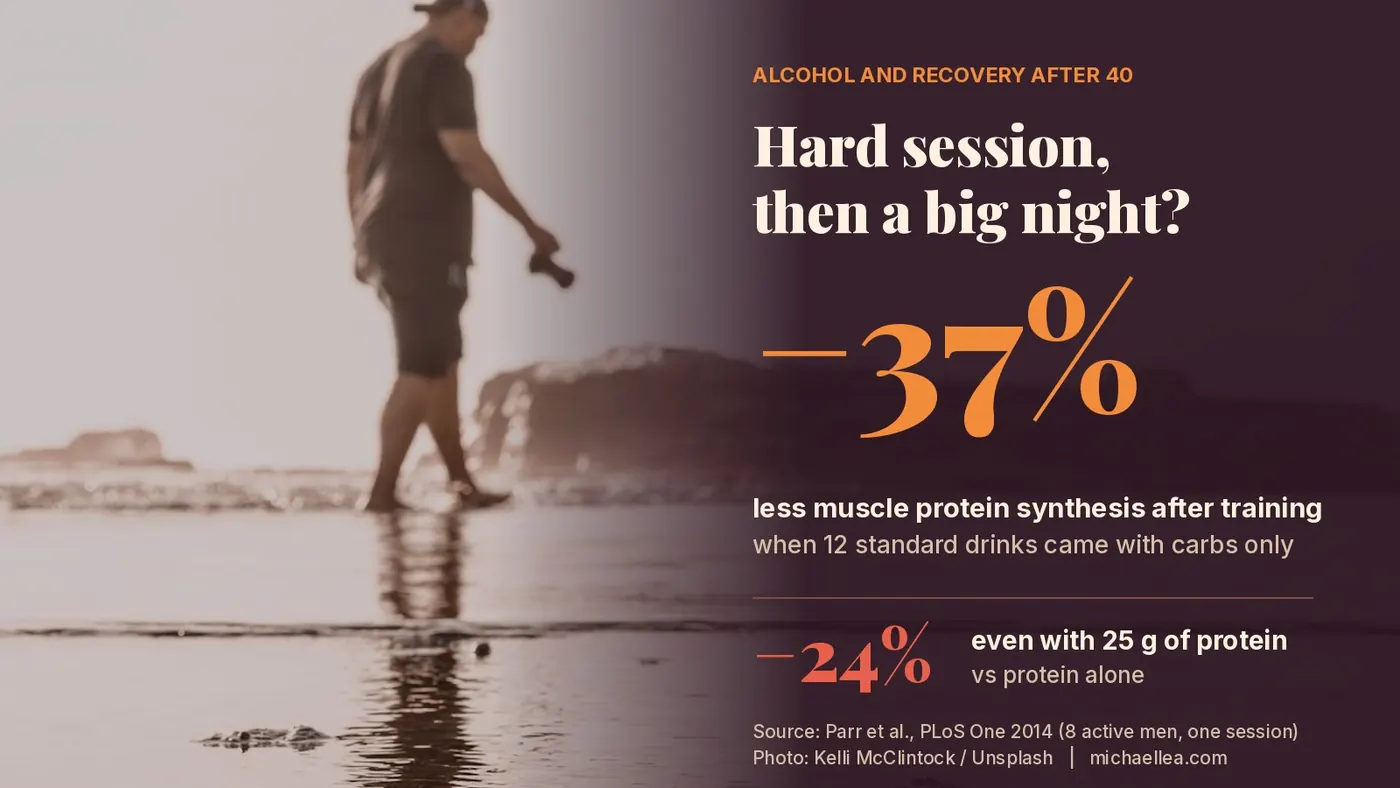
The best-known test is a small Australian trial from RMIT University. Eight physically active men did a hard session of leg extensions plus cycling. Afterwards they drank either 25 g of whey protein, or alcohol at 1.5 g per kilogram of body weight (about 12 standard drinks) with either protein or carbohydrate.
Muscle biopsies showed that muscle protein synthesis, the process that rebuilds muscle after training, was 24% lower when alcohol was taken with protein, and 37% lower when it was taken with carbohydrate, compared with protein alone. Training still raised protein synthesis in every group. Alcohol just blunted the gain.
Two caveats matter. The group was tiny, young and active, and 12 drinks is a heavy night, not a couple of beers. Treat the result as a clear signal about big sessions, not a verdict on every drink.
Will a few beers ruin my gains?
Probably not. A systematic review of 12 studies on alcohol after resistance exercise found no clear change in force, power, muscular endurance, soreness or creatine kinase (a marker of muscle damage). Muscle protein synthesis and testosterone seemed lower and cortisol seemed higher in the biological measures.
So the picture is mixed. You may feel and lift much the same the next day, while the rebuilding process underneath runs a little slower. Because most of those studies used large doses in a single sitting, "a few beers" is not well tested.
Does alcohol lower testosterone in men over 40?
It can, but dose and habit matter. A meta-analysis of 21 studies (30 trials, 10,199 men) found that regular, chronic drinking was linked with lower total and free testosterone and higher estradiol in healthy men. The same analysis did not see that effect after a single acute dose.
A separate review reached a similar view: low-to-moderate acute intake can raise testosterone for a short time, while large amounts and long-term heavy drinking push it down through stress hormones, inflammation and oxidative stress. These are mostly observational findings, so they show an association, not proof that cutting back will lift your levels. If you're worried about low testosterone, see your GP. We cover the training side in our guide to testosterone over 40.
How much alcohol is OK if I'm trying to build muscle or lose belly fat?
The Australian guidelines for healthy adults are no more than 10 standard drinks a week and no more than 4 on any one day. For a man trying to rebuild strength, that is a ceiling, not a target. A standard drink is 10 g of alcohol: roughly a 375 mL mid-strength beer, 100 mL of wine or a 30 mL nip of spirits.
Alcohol also carries energy of its own, and the drinks around it add up quickly. If belly fat is the goal, the weekly total usually matters more than any single session. Our posts on sleep and fat loss and protein after 40 cover the other two levers.
What should I do after a big night out?
- Eat protein. Protein alone gave the best result in the RMIT trial. It did not fully cancel the alcohol effect, but it is still the better option.
- Drink water alongside the alcohol and the next morning.
- Train anyway, but lighter. A walk or an easy session beats skipping the whole week.
- Keep your main lifting sessions away from the morning after. Plan the heavy day for when you are rested.
- Look at the weekly pattern. Two or three drinks on a couple of nights is a different story from a weekend binge.
If you drink most days, find it hard to stop, or take medication, talk to your GP before changing anything. If you're starting again after time off, our free Week Zero kit is a gentle way to build a routine that doesn't depend on willpower on a Monday.
Getting back into training after 40? The Comeback is my A$39, 8-week home program with a simple plan to restart. Get The Comeback →
Frequently asked questions
Does alcohol affect muscle growth more as you get older?
The research above was mostly in younger men, so we can't say that for sure. What we do know is that men over 40 usually have less margin to spare on recovery, sleep and hormones, so a heavy habit tends to show up sooner.
Is it better to skip alcohol completely?
For muscle, strength and body fat, less is better. Whether to drink at all is your call, and your GP can help if you want to cut down.
Can protein cancel out the effect of alcohol?
No. In the trial, taking protein with alcohol still left muscle protein synthesis 24% below protein alone, although it was better than carbohydrate.
References
Parr EB, Camera DM, Areta JL, Burke LM, Phillips SM, Hawley JA, Coffey VG. Alcohol ingestion impairs maximal post-exercise rates of myofibrillar protein synthesis following a single bout of concurrent training. PLoS One 2014;9(2):e88384. doi:10.1371/journal.pone.0088384
Lakićević N. The effects of alcohol consumption on recovery following resistance exercise: a systematic review. J Funct Morphol Kinesiol 2019;4(3):41. doi:10.3390/jfmk4030041
Santi D, Cignarelli A, Baldi M, Sansone A, Spaggiari G, Simoni M, Corona G. The chronic alcohol consumption influences the gonadal axis in men: results from a meta-analysis. Andrology 2023;12(4):768-780. doi:10.1111/andr.13526
Smith SJ, Lopresti AL, Fairchild TJ. The effects of alcohol on testosterone synthesis in men: a review. Expert Rev Endocrinol Metab 2023;18(2):155-166. doi:10.1080/17446651.2023.2184797
National Health and Medical Research Council. Australian guidelines to reduce health risks from drinking alcohol (2020). nhmrc.gov.au
General information only, not medical advice. Results vary.
Photo: Kelli McClintock on Unsplash