How Should Men Over 40 Start Strength Training After Years Off?
A beginner plan for getting strong again without hurting yourself in the first fortnight
Over 40 and getting back into training? Grab my free Week Zero starter kit: one test, one 35-minute home session and the traffic lights that stop you wrecking yourself in week one.
He's 47. He lifted through his twenties, played a bit of footy, then life happened: kids, a business, a dodgy shoulder, a couple of stressful years. Now he grunts getting off a low couch and he wants to start lifting again. He doesn't need a six-day split off YouTube. He needs a plan that gets him strong again without breaking him in the first fortnight. This is the one I'd hand him.
Why does strength training matter more for men over 40?
Muscle and strength fade if you stop using them, and you notice it in ordinary jobs: carrying the shopping, getting up off the floor with the kids, hauling a bag of mulch, taking the stairs without your knees complaining.
There's a bigger picture too. A 2022 review pooled 16 cohort studies and found muscle-strengthening activity was linked with a 10-17% lower risk of death from any cause, heart disease, total cancer and diabetes. The biggest gap showed up at about 30-60 minutes a week. These are observational studies, so they show a link, not proof. But 30-60 minutes is two or three short sessions. Australia's physical activity guidelines for adults ask for muscle-strengthening activity on at least two days a week.
How hard should you train when you're starting again?
For the first month, finish every set feeling like a 5 or 6 out of 10. You should have at least three reps left in the tank and be able to talk between sets.
It feels too easy. Good. Muscles adapt faster than tendons and joints, so the early weeks are about teaching your body to handle load again. The blokes who go hard in week one are the ones with a sore elbow in week three.
How many days a week should men over 40 lift?
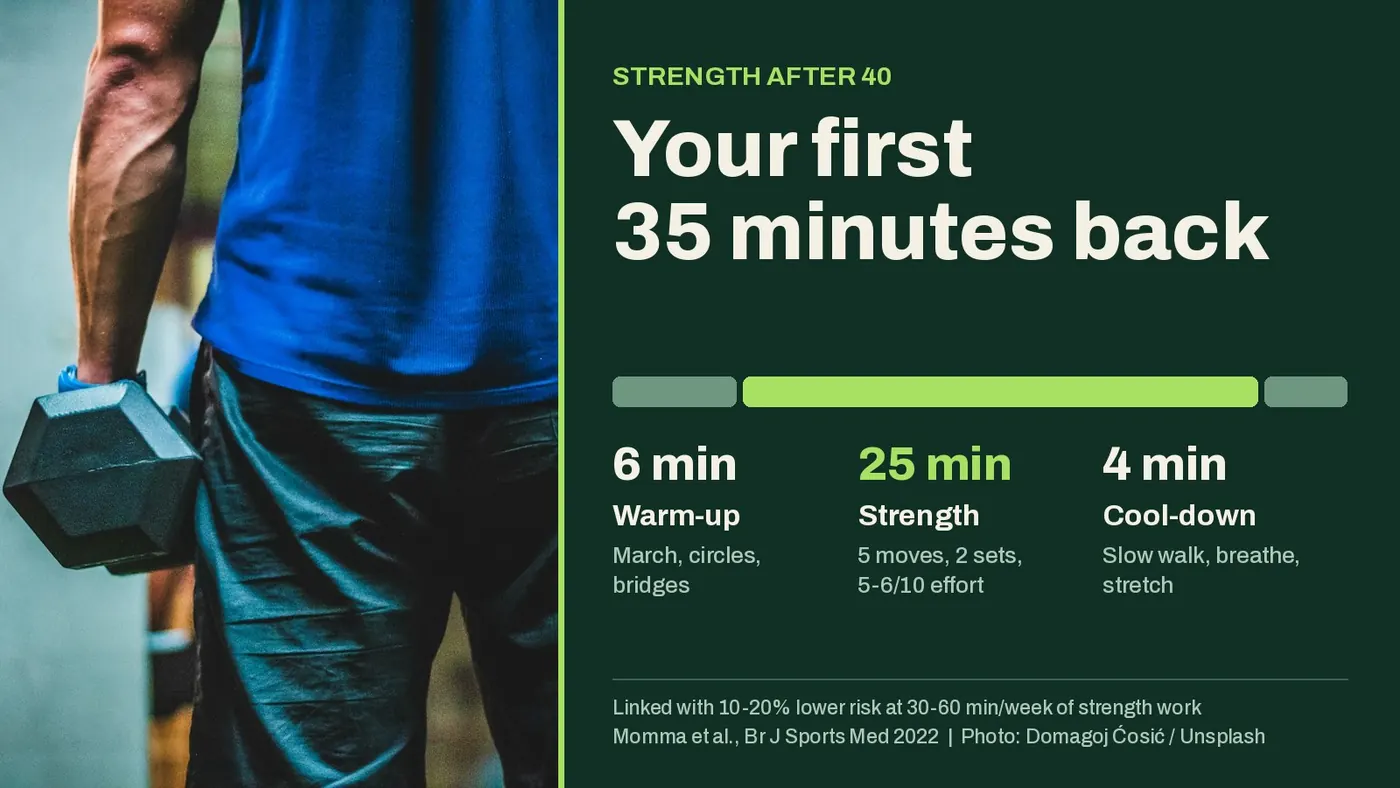
Three full-body sessions a week with a rest day between them suits most beginners. Monday, Wednesday and Friday works. Each session takes about 35 minutes. On the other days, go for an easy walk. It helps you recover without beating you up.
Can't manage three? Two is still a solid start and matches the guideline. Fit what you'll actually keep doing around work and family.
What are the best beginner exercises for men over 40?
A handful of movements covers almost everything:
- Squat: standing up from a chair, then a goblet squat holding one dumbbell
- Hinge: the Romanian deadlift, which teaches you to bend from the hips and not your back
- Push: an incline push-up with your hands on a bench
- Pull: a one-arm dumbbell row
- Single leg: a reverse lunge
- Carry: walking with a weight in one hand
- Trunk: dead bugs, bird dogs and glute bridges
Take about three seconds to lower each rep. It makes light weights work harder and keeps your technique honest.
What does a beginner workout look like in the first two weeks?
Alternate two sessions: A, B, A one week, then B, A, B the next. Start with a 6-minute warm-up (march on the spot, shoulder and hip circles, a few sit-to-stands and glute bridges). Finish with 4 minutes of slow walking and an easy stretch.
Session A (2 sets each): sit-to-stand x 6, incline push-up x 6, dumbbell row x 6 each side, glute bridge x 6, dead bug x 5 each side.
Session B (2 sets each): Romanian deadlift x 6, calf raise x 6, bird dog x 5 each side, goblet reverse lunge x 5 each side, suitcase carry 20 seconds each side.
In week two, add two reps to each exercise. Rest 60-90 seconds between sets and breathe out as you push or lift.
How heavy should you lift, and when is sore too sore?
Pick a weight where the last rep feels like a 5 or 6 out of 10. For most men coming back after years off, that's 2-6 kg in each hand. Yes, really. A 2016 meta-analysis of randomised trials found that in untrained people, loads at or below 50% of a one-rep max produced substantial gains in strength and muscle size. Heavier loads showed a trend towards bigger gains, but the difference wasn't statistically clear. So light is a fine place to begin. After that, add 1-2 kg every couple of weeks, not every session.
Use a traffic light for aches:
- Green (0-2 out of 10): normal muscle work. Carry on.
- Amber (3-4 out of 10): ease off with a lighter weight, a smaller range or an easier version.
- Red (5+ out of 10, or anything sharp, pinching or numb): stop that exercise. If it doesn't settle, see your GP or physio.
Strength after 40 isn't about chasing your old numbers. It's about being strong for the life you've got now, and sticking with it long enough to see it. Start lighter than your ego wants, keep to three sessions, and give it eight weeks. If you'd like a free place to begin, the Week Zero starter kit walks you through your first week back.
Frequently asked questions
Is it too late to start lifting at 45 or 50?
No. Start from where you are today, begin light and learn the basic movements first.
Do I need a gym?
No. A chair, a sturdy bench or table, a mat and a pair of dumbbells cover everything above. A gym gives you more room to grow later.
Should I see a doctor first?
If you've been inactive for a long time, or you have a heart condition, high blood pressure, diabetes, joint problems or take regular medication, check with your GP or physio before you start.
References
Momma H, Kawakami R, Honda T, Sawada SS. Muscle-strengthening activities are associated with lower risk and mortality in major non-communicable diseases: a systematic review and meta-analysis of cohort studies. Br J Sports Med 2022;56(13):755-763. doi:10.1136/bjsports-2021-105061
Schoenfeld BJ, Wilson JM, Lowery RP, Krieger JW. Muscular adaptations in low- versus high-load resistance training: a meta-analysis. Eur J Sport Sci 2016;16(1):1-10. doi:10.1080/17461391.2014.989922
Australian Government Department of Health. Physical activity and exercise guidelines for adults (18 to 64 years). health.gov.au
General information only, not medical advice. Results vary.
Photo: Domagoj Ćosić on Unsplash