How Long Does It Take to Get Back in Shape After Years Off?
How much you really lose when you stop, how quickly it comes back, and why the first few weeks matter most
Over 40 and getting back into training? Grab my free Week Zero starter kit: one test, one 35-minute home session and the traffic lights that stop you wrecking yourself in week one.
Every January, gyms fill with blokes loading the bar with what they benched at 30. Some get it off the rack and can't get it back up. Others don't come at all, because they've decided it's all gone. Both come from the same wrong idea: that the strength is either still there or gone for good. The research says neither. You've lost less than you fear, it comes back faster than it took to build, and the first month is where blokes over 40 either set it up or stuff it up.
How fast do you lose muscle and strength when you stop training?
Slower than the internet says. A meta-analysis pooled 103 studies on what happens when people stop resistance training (Bosquet et al., 2013). Strength dropped on every measure, and the longer the break, the bigger the drop. Losses were larger in people over 65 and in people who went back to doing nothing at all.
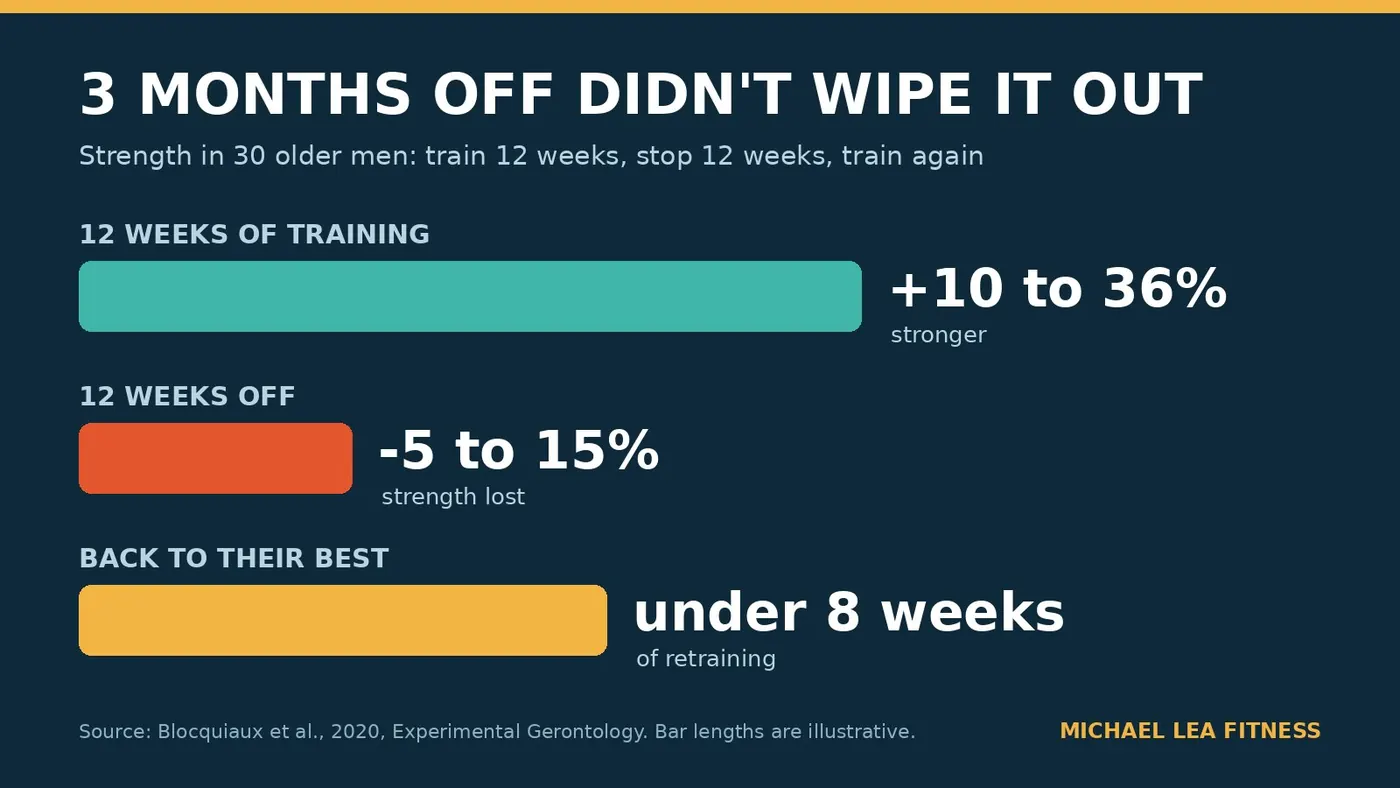
So a break costs you, and a long one costs more. But the size of the loss surprises people. In a Belgian study, 30 older men trained for 12 weeks and got 10 to 36 per cent stronger. Then they stopped for 12 weeks. They lost 5 to 15 per cent (Blocquiaux et al., 2020). Three months of nothing, and most of the gain was still there.
How quickly does fitness drop when you stop exercising?
Your lungs go before your muscles do. A review of detraining found that in people who'd only recently got fit, the gains in VO2max were completely gone after more than four weeks off, and some metabolic changes started within about 10 days (Mujika and Padilla, 2001). That review is old and leans on athletes and younger adults, so treat the exact timing as a guide.
It's why the squat can feel fine on your first day back, and the stairs out of the car park don't.
Is muscle memory real?
Partly, and not in the way it's usually sold. In one study, 19 untrained adults trained one leg for 10 weeks and then stopped for 20. The muscle they'd built shrank back to where it started. About 60 per cent of the strength they'd gained was still there (Psilander et al., 2019). The researchers put that down to the nervous system: your body had learned the skill of producing force, and it kept the skill.
What that study didn't find was the previously trained leg growing faster the second time round. The authors say their design couldn't properly test it, so it doesn't settle the question either way. The honest version is this: the skill of lifting sticks around for a long time, and whether the muscle itself has a head start is still being argued about.
How long does it take to get your strength back after a long break?
For a three-month break, we have a number. The men in the Belgian study were back to their best one-rep max in less than eight weeks of retraining, after taking 12 weeks to build it the first time (Blocquiaux et al., 2020). In another small study, young men who took three-week breaks between six-week training blocks ended up with similar size and strength after 24 weeks to a group who never stopped, because they gained faster each time they came back (Ogasawara et al., 2013).
For years off, nobody has run that study, so anyone giving you an exact date is guessing. What the evidence supports is the direction: it comes back quicker than it went on. The quickest way to slow it down is to get hurt in the first three weeks.
Do men over 40 lose gains faster than younger men?
There's no good study on men in their 40s specifically, so I won't pretend there is. The closest we have compared adults aged 20 to 35 with adults aged 60 to 75. After 16 weeks of training, both groups cut right back for 32 weeks. Strength held up well in both, even in the people who stopped completely. Muscle size was the difference. The younger group kept theirs on a third of the training. The older group didn't (Bickel et al., 2011).
At 45 you're somewhere between those two groups. The sensible read is that strength is stubborn at any age, and muscle gets harder to hold the older you get. That's an argument for not taking another ten years off.
How much training do you need to keep what you've built?
Less than it took to build it. In that same trial, younger adults held their muscle on a third of the training they'd been doing (Bickel et al., 2011). The older adults needed more than that to keep their size, though their strength hung on.
This is the part I'd want you to remember when work blows up or the kids' sport takes over your weekends. A busy month isn't the end. Cutting back keeps most of it. Stopping altogether is what costs you.
If it's been years, not weeks, start with the free Week Zero starter kit: one easy week to get your joints and lungs used to training again before you chase the old numbers.
Frequently asked questions
Should I go straight back to the weights I used to lift?
No. This is my coaching advice, not a study finding: your nervous system remembers how to push hard before your tendons and joints are ready to take it. Start well below your old numbers, leave a few reps in the tank, and add a little each week.
Does muscle memory still work after 5 or 10 years off?
Nobody has tested breaks that long in a proper trial. The longest ones here ran for months. Strength skill does seem to last, so expect to relearn faster than a true beginner, and don't expect it to be automatic.
Why do I feel so sore when I get back into training?
Because the work is new again to muscles that haven't done it for a while, and you probably did too much on day one. Soreness that eases over two or three days is normal. Sharp pain, or pain in a joint, isn't. Ease off, and see your GP or physio if it hangs around.
General fitness information only, not medical advice. If you have a heart condition, high blood pressure or an injury, check with your doctor before starting again.
References
- Bosquet L, Berryman N, Dupuy O, et al. (2013). Effect of training cessation on muscular performance: a meta-analysis. Scandinavian Journal of Medicine & Science in Sports, 23(3), e140-e149. https://doi.org/10.1111/sms.12047
- Blocquiaux S, Gorski T, Van Roie E, et al. (2020). The effect of resistance training, detraining and retraining on muscle strength and power, myofibre size, satellite cells and myonuclei in older men. Experimental Gerontology, 133, 110860. https://doi.org/10.1016/j.exger.2020.110860
- Bickel CS, Cross JM, Bamman MM. (2011). Exercise dosing to retain resistance training adaptations in young and older adults. Medicine & Science in Sports & Exercise, 43(7), 1177-1187. https://doi.org/10.1249/MSS.0b013e318207c15d
- Psilander N, Eftestøl E, Cumming KT, et al. (2019). Effects of training, detraining, and retraining on strength, hypertrophy, and myonuclear number in human skeletal muscle. Journal of Applied Physiology, 126(6), 1636-1645. https://doi.org/10.1152/japplphysiol.00917.2018
- Ogasawara R, Yasuda T, Ishii N, Abe T. (2013). Comparison of muscle hypertrophy following 6-month of continuous and periodic strength training. European Journal of Applied Physiology, 113(4), 975-985. https://doi.org/10.1007/s00421-012-2511-9
- Mujika I, Padilla S. (2001). Cardiorespiratory and metabolic characteristics of detraining in humans. Medicine & Science in Sports & Exercise, 33(3), 413-421. https://doi.org/10.1097/00005768-200103000-00013