Can You Strength Train With Bad Knees After 40?
Why lifting usually helps sore knees, which exercises to swap, and how much pain is okay
Over 40 and getting back into training? Grab my free Week Zero starter kit: one test, one 35-minute home session and the traffic lights that stop you wrecking yourself in week one.
"I'd love to train, Mick, but my knees are shot." I hear some version of that most weeks from blokes over 40. Usually it comes with a story: footy in his twenties, a bit of extra weight now, and a GP or a mate who said to take it easy. So he stopped doing legs, and the knees got worse anyway.
Here's what the research says about strength training with bad knees after 40, which exercises to swap, and how much discomfort is fine.
Is strength training bad for your knees after 40?
For most people with sore or arthritic knees, no. It's one of the best-supported treatments going.
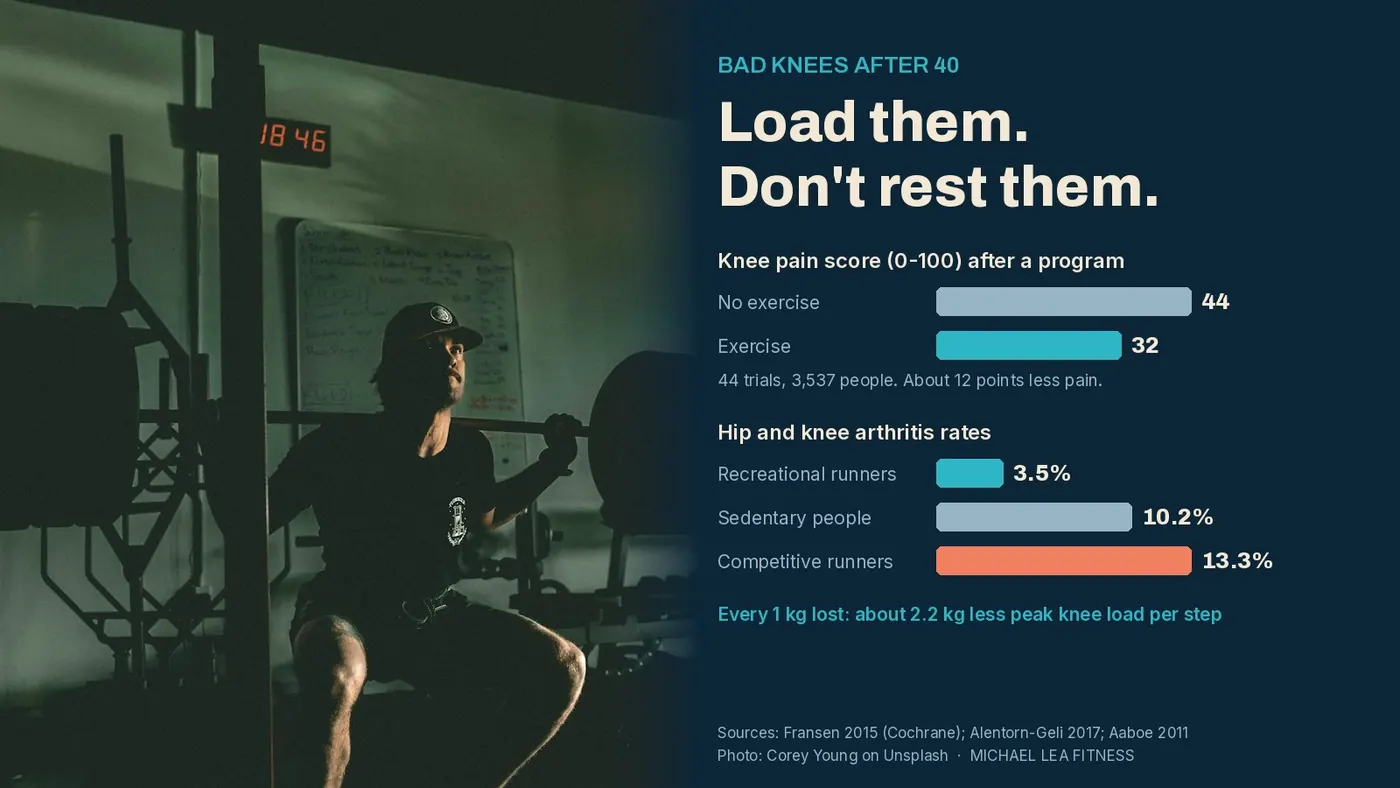
A Cochrane review pooled 44 trials and 3,537 people with knee osteoarthritis (Fransen et al., 2015). Land-based exercise cut knee pain by about 12 points on a 100-point scale and improved day-to-day function by about 10 points. The authors rated the evidence on pain as high quality and said the size of the effect was comparable to anti-inflammatory tablets. People who exercised were no more likely to drop out than those who didn't, and no trial reported a serious adverse event.
The fear underneath "take it easy" is usually that loading the joint grinds the cartilage away. A 2019 review of 12 randomised trials looked at blood and joint-fluid markers of cartilage breakdown and inflammation (Bricca et al., 2019). Exercise didn't push them up overall. Of 57 comparisons, 36 showed no change, 17 went down and only 4 went up.
Why do weak thighs make knee pain worse?
Your quads are the knee's shock absorbers. When they're strong, they control how fast you bend and straighten the joint, so less of each step jolts through the knee itself.
A 2022 review pooled 11 studies that followed 46,819 men and women for at least two years (Øiestad et al., 2022). Weak thigh muscles at the start were linked with about 43% higher odds of developing painful knee osteoarthritis in men. That's observational and the authors rated the evidence as low quality, so it doesn't prove weak quads cause arthritis. It does fit what I see on the gym floor. The blokes who skip legs to protect their knees tend to end up with weaker legs and the same sore knees.
How much knee pain is okay during exercise?
Some. That surprises people.
A review of seven trials compared exercise programs that allowed some pain with programs that stayed completely pain-free (Smith et al., 2017). The ones that let people work into a bit of discomfort did slightly better for pain in the short term, and after that the two came out level. The authors' conclusion: pain during exercise doesn't have to stop you getting better.
That's not a licence to grind through anything. Here's the traffic-light rule I use with clients, scoring the knee out of 10 during and after a set:
- Green, 0 to 2: a dull, mild ache. Carry on.
- Amber, 3 to 4: ease off. Lighter weight, a smaller range or an easier version.
- Red, 5 or more, or anything sharp, pinching or numb: stop that exercise for today.
Check the next morning too. If the knee's settled back to its usual by then, the dose was right. Swelling, locking or the knee giving way is a different story. Get that looked at by a GP or physio before you load it.
What are the best leg exercises for bad knees?
The ones you can do in the green zone. Swap the version that hurts for one that doesn't, and keep training the legs.
- Deep squats hurt? Squat down to a box or chair at a height that's comfortable. Lower the box a few centimetres every couple of weeks if it stays green.
- Lunges hurt? Try step-ups onto a low step, taking three seconds to lower back down.
- Stairs or kneeling hurt? Glute bridges, hip hinges and hamstring curls build the muscles around the knee without bending it deeply.
- Everything hurts today? Sit on a chair and straighten one leg, hold for five seconds, then lower slowly. Ten each side still counts.
Start lighter than your ego wants, two or three sets, two or three times a week. Add a little weight or a few reps every couple of weeks, not every session. If you'd like that laid out for you, The Comeback is my 8-week home program for men over 40, with the traffic lights built into every session and an easier version of every leg exercise.
Does losing weight take load off your knees?
Yes, and more than the number on the scales suggests. In a study of 157 adults with obesity and knee osteoarthritis, a 16-week diet produced an average loss of 13.7 kg (Aaboe et al., 2011). For every kilo lost, peak load through the knee while walking dropped by about 2.2 kg.
So a bloke who drops 5 kg takes roughly 11 kg off his knees at the peak of every step. Strength work and a bit of weight loss together are a good team for sore knees.
Frequently asked questions
Should I stop running if my knees hurt?
Not automatically. A review of 25 studies found hip and knee arthritis in 3.5% of recreational runners, compared with 10.2% of sedentary people and 13.3% of competitive runners (Alentorn-Geli et al., 2017). Those are associations, not proof, but casual running isn't linked with wrecked knees. If running pushes you into amber, cut the distance, run on grass or swap in the bike for a few weeks while you build leg strength.
Do I need a scan before I start?
Usually not. Exercise is a first-line treatment for sore knees either way. See your GP or a physio first if the knee is hot and swollen, locks, gives way, or you can't put weight on it.
How long before my knees feel better?
Give it six to eight weeks of steady, green-zone training before you judge it. In the Cochrane review, a smaller benefit was still there two to six months after programs finished, so keep going once it's working.
Knee pain is a reason to change the exercise, not to stop training. Pick one swap from the list above and do it three times this week. If you'd like a simple first week to follow, the free Week Zero kit is on this page.
References
Fransen M, McConnell S, Harmer AR, et al. Exercise for osteoarthritis of the knee. Cochrane Database Syst Rev 2015;1:CD004376. doi:10.1002/14651858.CD004376.pub3
Bricca A, Struglics A, Larsson S, et al. Impact of exercise therapy on molecular biomarkers related to cartilage and inflammation in individuals at risk of, or with established, knee osteoarthritis: a systematic review and meta-analysis of randomized controlled trials. Arthritis Care Res 2019;71(11):1504-1515. doi:10.1002/acr.23786
Øiestad BE, Juhl CB, Culvenor AG, et al. Knee extensor muscle weakness is a risk factor for the development of knee osteoarthritis: an updated systematic review and meta-analysis including 46 819 men and women. Br J Sports Med 2022;56(6):349-355. doi:10.1136/bjsports-2021-104861
Smith BE, Hendrick P, Smith TO, et al. Should exercises be painful in the management of chronic musculoskeletal pain? A systematic review and meta-analysis. Br J Sports Med 2017;51(23):1679-1687. doi:10.1136/bjsports-2016-097383
Aaboe J, Bliddal H, Messier SP, et al. Effects of an intensive weight loss program on knee joint loading in obese adults with knee osteoarthritis. Osteoarthritis Cartilage 2011;19(7):822-828. doi:10.1016/j.joca.2011.03.006
Alentorn-Geli E, Samuelsson K, Musahl V, et al. The association of recreational and competitive running with hip and knee osteoarthritis: a systematic review and meta-analysis. J Orthop Sports Phys Ther 2017;47(6):373-390. doi:10.2519/jospt.2017.7137
General information only, not medical advice. Results vary.
Photo: Corey Young on Unsplash