Should Men Over 40 Take Creatine? What the Evidence Shows
How much to take, what it does for strength, and the truth about kidneys and hair loss
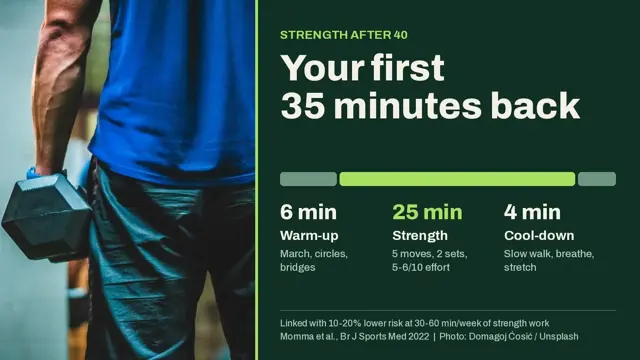
Over 40 and getting back into training? Grab my free Week Zero starter kit: one test, one 35-minute home session and the traffic lights that stop you wrecking yourself in week one.
Walk into any supplement shop and creatine sits next to the pre-workouts with the neon labels, so plenty of blokes over 40 assume it's something for 22-year-olds chasing a pump. It isn't. Creatine monohydrate is one of the most studied supplements in sport science, with more than 500 peer-reviewed papers behind it, and a fair chunk of that research is in middle-aged and older adults.
So should you take it? If you're lifting weights, probably yes. If you aren't, it won't do much for you yet. Here's what the research shows, how much to take, and the two worries I hear most: kidneys and hair.
What does creatine actually do for men over 40?
Your muscles store creatine and use it to refill their energy supply during short, hard efforts: a heavy set of squats, a sprint up the stairs, carrying the shopping in one trip. Taking it as a supplement tops those stores up. That lets you squeeze out a rep or two more per set, and over months those extra reps add up to more strength.
That's the key point. Creatine doesn't build muscle by itself. It helps you train a bit harder, and the training builds the muscle.
That matters after 40 because muscle and strength slowly drop away with age unless you give them a reason to stay. Anything that makes your lifting sessions more productive is worth a look.
Does creatine build muscle and strength after 40?
The best evidence comes from meta-analyses, which pool the results of many trials.
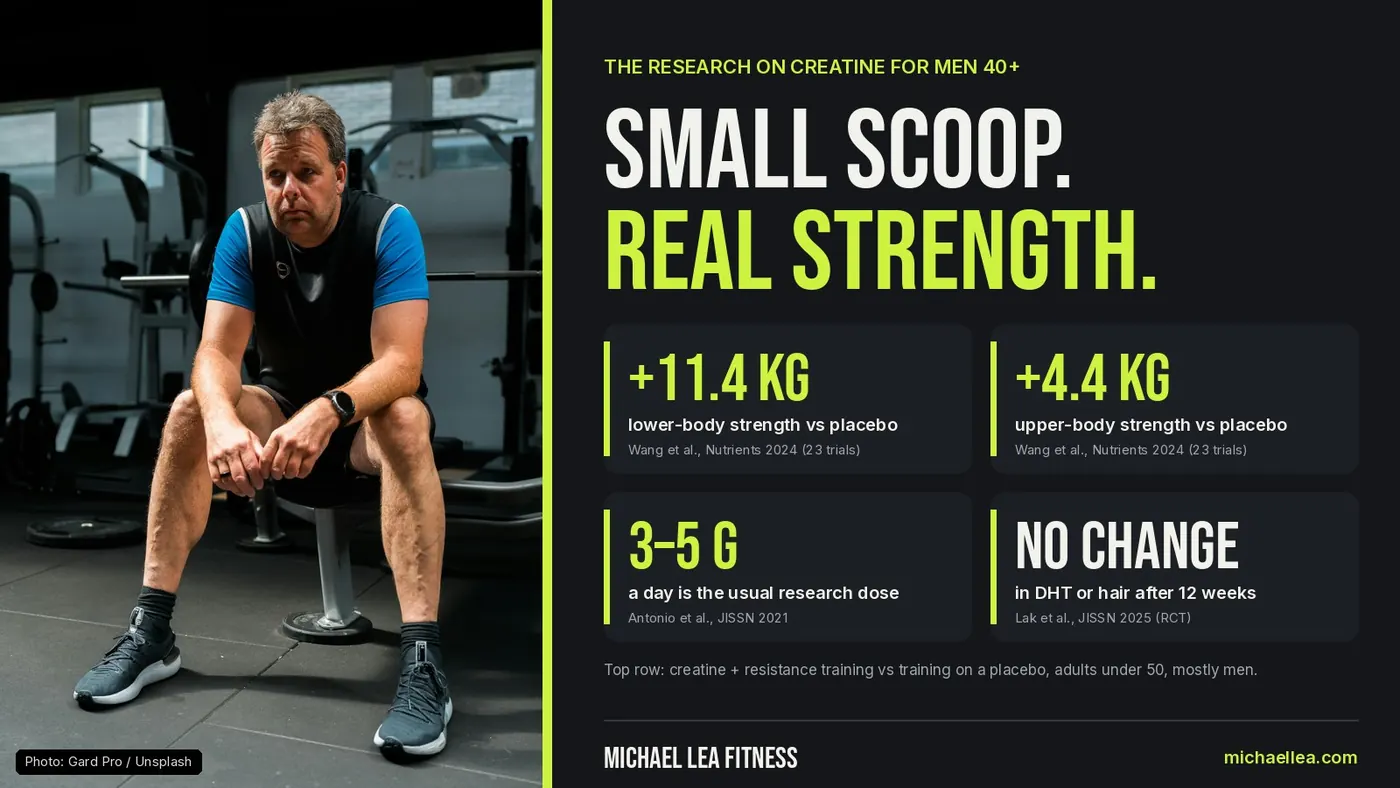
- A 2024 review of 23 trials in adults under 50, almost all men, found creatine plus resistance training added about 4.4 kg to upper-body strength and 11.4 kg to lower-body strength compared with lifting on a placebo.
- A 2026 review of 11 trials in adults aged 60 and over found a small but real extra gain in strength. The extra effect on muscle mass and day-to-day physical function wasn't clear enough to call.
- A 2023 review that measured muscle size directly with scans found a small boost in muscle thickness, a little smaller in older adults than younger ones.
If you're 40 to 60, you sit between those groups. The honest summary: creatine gives you a modest edge in strength on top of good training, and maybe a little extra muscle. It won't turn a so-so program into a great one.
How much creatine should men over 40 take?
Keep it simple. The usual dose in the research is 3 to 5 grams a day of plain creatine monohydrate, roughly a level teaspoon.
Some people "load" with about 20 grams a day for 5 to 7 days to fill the muscles faster. You don't have to. A daily 3 to 5 grams gets you to the same place, it just takes a few weeks longer. If you do load, split it across the day, as big single doses can upset your stomach.
Timing isn't a big deal. Take it with breakfast, in your post-training shake, whenever you'll remember. One 2021 review of older adults found that taking creatine only on training days still improved lean mass and strength compared with placebo, so if you lift three days a week and forget the other four, you haven't wasted your money.
Skip the fancy versions. The expert review below found no good evidence that buffered creatine, creatine HCl or the rest beat plain monohydrate, which is also the cheapest.
Is creatine safe for your kidneys?
For healthy men, the research is reassuring. The International Society of Sports Nutrition's position stand reviewed trials using up to 30 grams a day for as long as five years and concluded creatine was safe and well tolerated in healthy people. That's six times the usual dose.
One thing to know: creatine can nudge up a blood test called creatinine, which doctors use as a rough kidney check. That can look like a problem on paper when it isn't. If you're having bloods done, tell your GP you take it.
If you already have kidney disease, diabetes affecting your kidneys, or you're on medication for your kidneys or blood pressure, talk to your GP before you start. That's the group where the safety data is thinnest.
Does creatine cause hair loss or affect testosterone?
This is the one I get asked about most by men over 40, especially those already watching their hairline.
The worry came from the idea that creatine raises DHT, the hormone linked with male-pattern baldness. A 2025 randomised controlled trial put it to the test. Men took 5 grams of creatine or a placebo every day for 12 weeks, and the researchers measured testosterone, DHT and hair density, thickness and follicle counts. There was no difference between the groups on any of them.
Fair caveat: those men were 18 to 40 and it ran for three months. But it's the first trial to look at hair directly, and it found nothing. Creatine isn't a steroid either, and it doesn't act like one.
What you might notice is the scales ticking up a little in the first few weeks. That's mostly water pulled into the muscle, not fat.
Frequently asked questions
Do I need creatine if I'm just getting back into training?
No. In your first few months back, showing up two or three times a week matters far more than any supplement. Creatine is a small extra once the habit is set. If money's tight, spend it on decent shoes and some dumbbells first.
Can I get enough creatine from food?
Red meat and fish contain some, but you'd need to eat well over a kilo of raw steak a day to match a 5 gram dose. A supplement is the practical way to get the amount used in the research.
Should I stop taking creatine at some point?
There's no need to cycle it. If you stop, your muscle stores drift back to normal over a few weeks and you lose the small extra boost, not the strength you've built.
If you're over 40 and want somewhere sensible to start, sort the training first and add creatine later. The free Week Zero starter kit walks you through your first week back, no gym membership needed.
References
Wang Z, Qiu B, Li R, et al. Effects of creatine supplementation and resistance training on muscle strength gains in adults <50 years of age: a systematic review and meta-analysis. Nutrients 2024;16(21):3665. doi:10.3390/nu16213665
Yao L, Yang D, Gao J. Effects of resistance training combined with creatine supplementation on muscle strength, physical function, and muscle mass in older adults: a systematic review and three-level meta-analysis. Front Nutr 2026;13:1919884. doi:10.3389/fnut.2026.1919884
Burke R, Piñero A, Coleman M, et al. The effects of creatine supplementation combined with resistance training on regional measures of muscle hypertrophy: a systematic review with meta-analysis. Nutrients 2023;15(9):2116. doi:10.3390/nu15092116
Forbes SC, Candow DG, Ostojic SM, et al. Meta-analysis examining the importance of creatine ingestion strategies on lean tissue mass and strength in older adults. Nutrients 2021;13(6):1912. doi:10.3390/nu13061912
Antonio J, Candow DG, Forbes SC, et al. Common questions and misconceptions about creatine supplementation: what does the scientific evidence really show? J Int Soc Sports Nutr 2021;18(1):13. doi:10.1186/s12970-021-00412-w
Kreider RB, Kalman DS, Antonio J, et al. International Society of Sports Nutrition position stand: safety and efficacy of creatine supplementation in exercise, sport, and medicine. J Int Soc Sports Nutr 2017;14:18. doi:10.1186/s12970-017-0173-z
Lak M, Forbes SC, Ashtary-Larky D, et al. Does creatine cause hair loss? A 12-week randomized controlled trial. J Int Soc Sports Nutr 2025;22(sup1):2495229. doi:10.1080/15502783.2025.2495229
General information only, not medical advice. Results vary.
Photo: Gard Pro on Unsplash